Climatology calculations
[1]:
from earthkit import data as ekd
from earthkit import plots as ekp
from earthkit import transforms as ekt
from earthkit.transforms._tools import earthkit_remote_test_data_file
Load test data
In this example we will use hourly ERA5 2m temperature point data (51.5˚ N, -1.0˚ E) for the years 1940 to 2025 as our physical data. This data was originally sourced from the ERA5 single levels time-series collection in the CDS.
[2]:
# Get some demonstration ERA5 data, this could be any url or path to an ERA5 grib or netCDF file.
remote_era5_file = earthkit_remote_test_data_file("ERA5-Reading-2m-temperature-1940-2025.nc")
era5_data = ekd.from_source("url", remote_era5_file)

# convert to xarray to save repeated conversion in further steps.
# As the data is small, we can compute it here, but for larger datasets you may want to delay this until later steps.
era5_xr = era5_data.to_xarray()
era5_xr
[2]:
<xarray.Dataset> Size: 9MB
Dimensions:     (valid_time: 753888)
Coordinates:
  * valid_time  (valid_time) datetime64[ns] 6MB 1940-01-01 ... 2025-12-31T23:...
    latitude    float64 8B ...
    longitude   float64 8B ...
Data variables:
    t2m         (valid_time) float32 3MB ...
Attributes:
    Conventions:             CF-1.7
    GRIB_centre:             ecmf
    GRIB_centreDescription:  European Centre for Medium-Range Weather Forecasts
    GRIB_edition:            1
    GRIB_subCentre:          0
    history:                 2024-09-02T04:48 GRIB to CDM+CF via cfgrib-0.9.1...
institution: European Centre for Medium-Range Weather ForecastsCalculate the climatologies
The climatology module offers a range of methods for calculating climatological statistics. First we will use the basic methods to calculate climatological mean and standard-deviation representative of the climatology period 1991-2020.
The climatology_range must provide the start and end date for the climatology period. It can be provided as date strings which are recognised by xarray, for example "YYYY", "YYYY-MM" and "YYYY-MM-DD", or as a date objects such as datetime objects or numpy.datetime64 objects.
If the climatology range is not provided, then the whole time-period in the input data is used.
[3]:
climatology_mean = ekt.climatology.mean(era5_xr, climatology_range=("1991", "2020"))
climatology_std = ekt.climatology.std(era5_xr, climatology_range=("1991", "2020"))
print(
    f"Climatology mean = {float(climatology_mean.t2m)}\nClimatology standard deviation = {float(climatology_std.t2m)}"
)
climatology_mean
Climatology mean = 283.6854248046875
Climatology standard deviation = 5.9290385246276855
[3]:
<xarray.Dataset> Size: 20B
Dimensions:    ()
Coordinates:
    latitude   float64 8B ...
    longitude  float64 8B ...
Data variables:
    t2m        float32 4B 283.7
Attributes:
    Conventions:             CF-1.7
    GRIB_centre:             ecmf
    GRIB_centreDescription:  European Centre for Medium-Range Weather Forecasts
    GRIB_edition:            1
    GRIB_subCentre:          0
    history:                 2024-09-02T04:48 GRIB to CDM+CF via cfgrib-0.9.1...
institution: European Centre for Medium-Range Weather ForecastsThese functions are both wrappers of the base ekt.climatology.reduce function, where how is set to "mean" and "std" respectively.
Monthly climatology
It is possible to calculate monthly climatological statistics using the monthly_reduce function, and a range of functions which wrap this. The monthly climatologies provide a value of the requested statistic for each calendar month, over the climatology_range period.
In the example below, we calculate the monthly mean for our 2m temperature data for the climatology_range 1990 to 2020. In the returned object the valid_time dimension has been replaced with a month dimension with values 1 to 12 corresponding to months January to December.
[4]:
climatology_monthly_mean = ekt.climatology.monthly_mean(era5_xr, climatology_range=("1991", "2020"))
climatology_monthly_mean
[4]:
<xarray.Dataset> Size: 160B
Dimensions:    (month: 12)
Coordinates:
  * month      (month) int64 96B 1 2 3 4 5 6 7 8 9 10 11 12
    latitude   float64 8B 51.5
    longitude  float64 8B -1.0
Data variables:
    t2m        (month) float32 48B 278.0 278.2 280.0 282.3 ... 284.2 280.8 278.4
Attributes:
    Conventions:             CF-1.7
    GRIB_centre:             ecmf
    GRIB_centreDescription:  European Centre for Medium-Range Weather Forecasts
    GRIB_edition:            1
    GRIB_subCentre:          0
    history:                 2024-09-02T04:48 GRIB to CDM+CF via cfgrib-0.9.1...
institution: European Centre for Medium-Range Weather ForecastsDaily mean, min, max and standard deviation
We can perform similar calculations for the daily mean, minimum, maximum and standard deviation. This time the valid_time is replaced with a dayofyear dimension with values 1 to 366.
The 366th value is due to leap years, and it is the 366th value that is under-sampled (i.e. one value every 4 years).
[5]:
climatology_daily_mean = ekt.climatology.daily_mean(era5_xr, climatology_range=("1991", "2020"))
climatology_daily_max = ekt.climatology.daily_max(era5_xr, climatology_range=("1991", "2020"))
climatology_daily_min = ekt.climatology.daily_min(era5_xr, climatology_range=("1991", "2020"))
climatology_daily_std = ekt.climatology.daily_std(era5_xr, climatology_range=("1991", "2020"))

climatology_daily_mean
[5]:
<xarray.Dataset> Size: 4kB
Dimensions:    (dayofyear: 366)
Coordinates:
  * dayofyear  (dayofyear) int64 3kB 1 2 3 4 5 6 7 ... 361 362 363 364 365 366
    latitude   float64 8B 51.5
    longitude  float64 8B -1.0
Data variables:
    t2m        (dayofyear) float32 1kB 278.3 278.0 277.6 ... 277.9 277.9 276.0
Attributes:
    Conventions:             CF-1.7
    GRIB_centre:             ecmf
    GRIB_centreDescription:  European Centre for Medium-Range Weather Forecasts
    GRIB_edition:            1
    GRIB_subCentre:          0
    history:                 2024-09-02T04:48 GRIB to CDM+CF via cfgrib-0.9.1...
institution: European Centre for Medium-Range Weather ForecastsMonthly quantiles
The API for climatology quantiles is slightly different, it requires an additional argument q which is a list of the quantiles to return. Additionally, the returned object has quantiles dimension which is for each of the quantiles returned.
[6]:
climatology_monthly_quantiles = ekt.climatology.quantiles(
    era5_xr, [0.1, 0.5, 0.9], frequency="month", climatology_range=("1991", "2020")
)
climatology_monthly_quantiles
[6]:
<xarray.Dataset> Size: 408B
Dimensions:   (quantile: 3, month: 12)
Coordinates:
  * quantile  (quantile) float64 24B 0.1 0.5 0.9
  * month     (month) int64 96B 1 2 3 4 5 6 7 8 9 10 11 12
Data variables:
    t2m       (quantile, month) float64 288B dask.array<chunksize=(1, 1), meta=np.ndarray>
Attributes:
    Conventions:             CF-1.7
    GRIB_centre:             ecmf
    GRIB_centreDescription:  European Centre for Medium-Range Weather Forecasts
    GRIB_edition:            1
    GRIB_subCentre:          0
    history:                 2024-09-02T04:48 GRIB to CDM+CF via cfgrib-0.9.1...
institution: European Centre for Medium-Range Weather ForecastsPlot the output
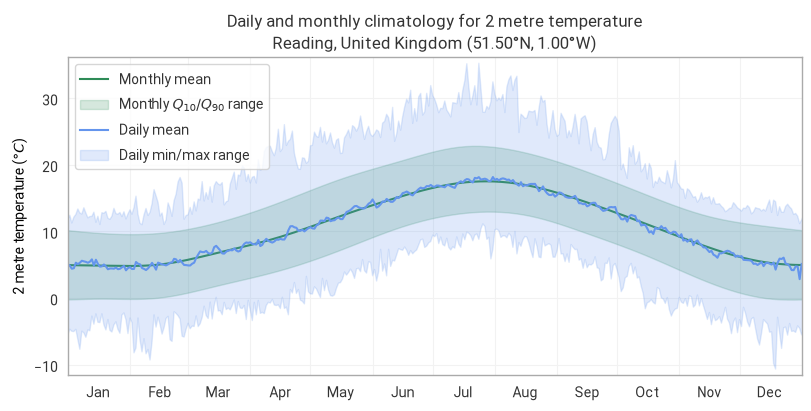
First we plot the climatology data using an earthkit-plots Climatology figure.
[7]:
chart = ekp.Climatology(wrap_time=True)

chart.fix_y_units("celsius")

# Monthly mean + q10/q90 envelope
chart.line(climatology_monthly_mean, label="Monthly mean", color="seagreen", drawstyle="spline")
chart.fill_between(
    climatology_monthly_quantiles.sel(quantile=0.1),
    climatology_monthly_quantiles.sel(quantile=0.9),
    label="Monthly $Q_{10} / Q_{90}$ range",
    color="seagreen",
    drawstyle="spline",
)

# Daily mean + min/max envelope
chart.line(
    climatology_daily_mean,
    label="Daily mean",
    color="cornflowerblue",
)
chart.fill_between(
    climatology_daily_min,
    climatology_daily_max,
    label="Daily min/max range",
    color="cornflowerblue",
)

chart.title(
    "Daily and monthly climatology for {variable_name}\n{location:%c}, {location:%C} ({latitude:%Lt}, {longitude:%Ln})"
)
chart.xticks(frequency="M", period=True)
chart.ylabel()
chart.legend()
chart.show()
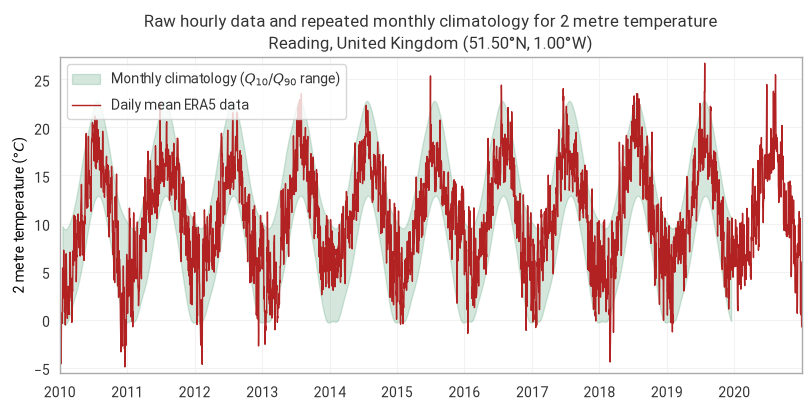
Now we add the climatology to the background of the Timeseries plot for the daily mean on the original valid_time dimension. First we create the repeated climatology for the monthly quantiles, then we plot with earthkit-plots
[8]:
latitude = 51.5
longitude = -1.0

chart = ekp.TimeSeries()

# repeat_years tiles the month-dimensioned climatology across 2015–2017
# automatically — no dummy datetime coordinates needed.
chart.fill_between(
    climatology_monthly_quantiles.sel(quantile=0.1),
    climatology_monthly_quantiles.sel(quantile=0.9),
    units="celsius",
    label="Monthly climatology ($Q_{10} / Q_{90}$ range)",
    color="seagreen",
    drawstyle="spline",
    repeat_years=range(2010, 2020),
)

era5_daily_mean = ekt.temporal.daily_mean(era5_xr)
chart.line(
    era5_daily_mean.sel(valid_time=slice("2010", "2020")),
    units="celsius",
    label="Daily mean ERA5 data",
    color="firebrick",
    lw=1,
)

chart.title(
    "Raw hourly data and repeated monthly climatology for {variable_name}\n"
    "{location:%c}, {location:%C} ({latitude:%Lt}, {longitude:%Ln})"
)

chart.ylabel()
chart.legend()
chart.show()
[ ]: